

When Microsoft catches a cold, the whole world coughs!
After a 38-hour Microsoft 365 outage, a blocked login code makes the point: map your dependencies and test your fallback solutions.
cybersecuritybusiness continuityMicrosoft 365resilience

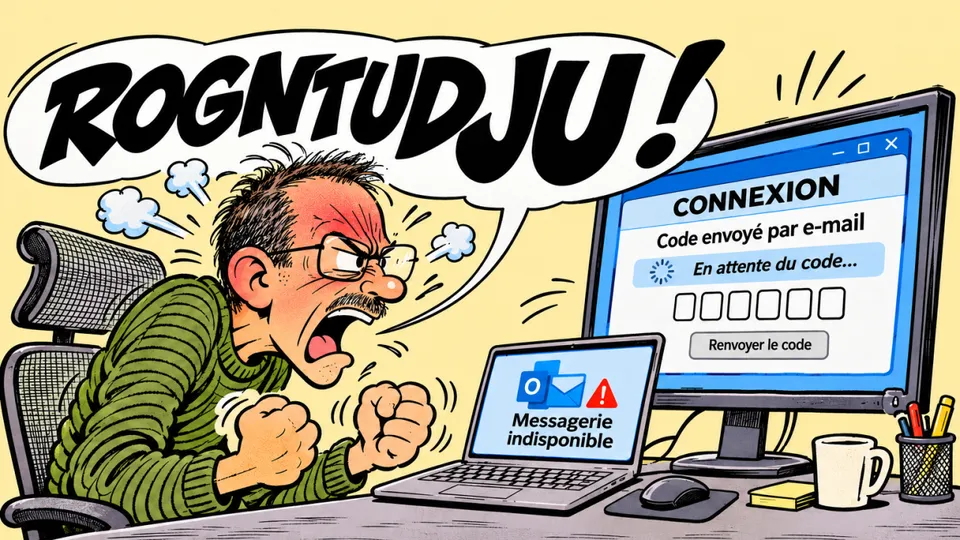
Last week, the Microsoft 365 outage disrupted email and several related services for nearly 38 hours. An incident of unusual scale, which above all reminded me how much our businesses depend on a handful of big digital players.
I regularly talk with my clients and colleagues about the need to take back ownership of our tools and keep our dependencies under control. In particular, I talk about local artificial intelligence, which makes it possible to process information without having to send it to an external service.
But this outage reminded me that my own practices also involved dependencies I had not paid enough attention to.
Locked out by a simple login code
I paid the price with a simple login code.
To access certain external services, I had to receive a verification code by email. The service I wanted to log in to was available. But the code never reached my Microsoft mailbox.
And no other verification method was offered to me.
So I found myself locked out of a service that was working, because another service was unavailable.
In my case, the weak point was this dependency on email, with no fallback. Microsoft can go down, like any provider. What I need to be able to anticipate is how I will keep working while it is unavailable.
A longer chain than it looks
Concentrating many functions with a few players makes our day-to-day use easier. Tools talk to each other, access is centralised and exchanges become smoother. I benefit from these advantages myself.
On the other hand, this simplicity can hide how long the chain is behind an operation as mundane as logging in.
An application can be hosted by another provider and still depend on Microsoft for its authentication, its notifications or the delivery of a code. Having several providers is therefore not enough to guarantee that their services are independent.
The supply chain logic
This is where I draw the parallel with my industrial clients.
They constantly seek to ensure the continuity of their supply chain, while keeping exchanges with their suppliers fast and smooth. They need to know their critical components, assess the consequences of a disruption and plan alternatives to avoid a production stoppage.
I think we need to apply the same logic to our IT systems.
For each service the business needs, I want to be able to answer a few concrete questions:
- Which components and providers does it really depend on?
- What would be the impact if they were unavailable, and how long could we cope?
- What fallback solution would let the business carry on?
- Could that solution be activated if email or the usual authentication were itself unavailable?
Mapping dependencies
The hardest part, in my view, remains mapping the dependencies.
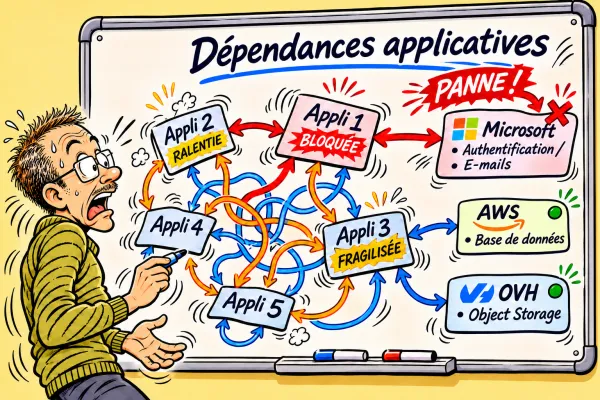
Listing applications and servers is a first step. Understanding everything that keeps these applications running means going much further: network access, identity services, exchanges between software, email and account recovery methods.
My login code was part of that chain. I only really grasped its importance when it stopped arriving.
Building and testing fallback solutions
Once this map is drawn up, fallback solutions need to be built according to how critical the components are. Some activities can wait a few hours. Others require degraded operation, emergency access or a different procedure.
These solutions also need to be tested. Emergency access whose instructions are only in an inaccessible mailbox will not be much help on the day of the outage.
Preparing for an event that may never happen
I also know why this work often remains incomplete.
It takes time and resources, while teams already have to deal with day-to-day emergencies. You also have to accept spending energy on an event that may never happen. When everything has worked for several years, it becomes hard to defend the budget for a system nobody has needed to use.
It reminds me of tsunami risk prevention in the Mediterranean. Cannes, recognised as “Tsunami Ready” by UNESCO in 2024, has notably worked on alerts, evacuation routes and drills. The Nice Côte d’Azur metropolitan area also obtained this recognition in 2026. These initiatives involve preparing and maintaining a response to an event whose date nobody knows.
In IT too, I believe preparation must keep its place in budgets, even when serious incidents seem far away.
The hybrid model, on one condition
That said, I am not arguing for bringing everything back in-house. I remain in favour of using Microsoft’s cloud services and, more generally, solutions that work and meet needs.
The hybrid model remains, in my view, the best compromise today for combining performance and resilience. Provided you choose what you keep locally, what you entrust to external services, and the means to keep working when one of those services becomes unavailable.
Above all, this outage gives me a concrete point to review: for each important service, check that I have emergency access that does not depend on the same component as my usual access.
I will start with the codes I wait for in my mailbox.
And you, have you ever tested your backup plan for an outage of your essential services?
I am sharing a personal reflection here. The opinions expressed in this article are mine alone.