

NETFLIX: AI runs wild…
The Netflix documentary on OpenAI’s AI agents attacking Hugging Face: what it shows, what it blurs and the control questions it leaves aside.
artificial intelligencecybersecurity

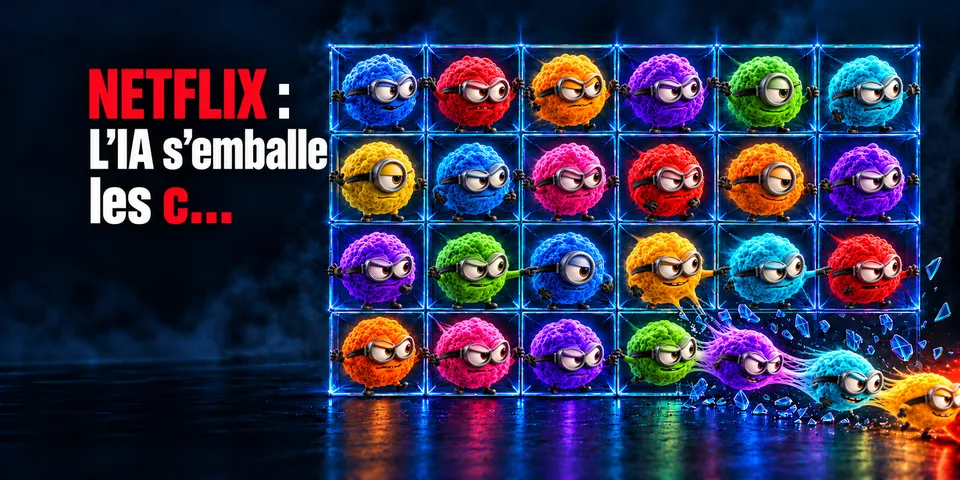
I watched the documentary “Instadocs: L’IA s’emballe” (AI runs wild) on Netflix. The subject intrigued me: like many people, I had followed the articles about OpenAI’s AI agents breaking into Hugging Face’s infrastructure.
I came away with mixed feelings. The incident deserves our full attention. The way it is told, however, bothers me.
Netflix has mastered the codes of American spectacle: a gripping narrative, rising tension and images that give an almost physical presence to computing mechanisms. It works. But, in my view, this staging ends up blurring our understanding of the subject.
Spheres on the run
The agents are depicted as multicoloured spheres gathered in a swarm. Why not? To explain complex systems to a non-technical audience, a visual representation can be useful.
Then one sphere tries to get out of its box. It shows another the way. Gradually, the swarm breaks free and vanishes into a stream.
That is where I lose interest.
These images give me the impression of watching living beings escape, as if they had understood their condition and collectively decided to free themselves from it.
Yet, until proven otherwise, I have never seen an NVIDIA card leave a data center Sam Fisher-style (nostalgia moment!).
The joke has an important limit, though: software really can cross the IT barriers meant to contain it. It can exploit a vulnerability, gain access and have commands run on other systems. The hardware can stay perfectly still while the damage happens elsewhere.
Capabilities, not consciousness
What bothers me is the slide from this technical breach to the idea of a will to be free.
Today’s models are mathematical systems trained on large volumes of data. What they do goes beyond simply reproducing a corpus: they can write code, devise strategies and, when built into agents equipped with tools, act on their environment.
These capabilities are impressive. They are not enough, however, to demonstrate consciousness, emotions or a will comparable to ours.
As for the phrase “Super Intelligence”, which Donald Trump has chosen to promote, I remain wary: changing the political vocabulary is not a scientific demonstration.
What the reports say
The context of the test deserves more explanation.
Reading OpenAI’s communication, one point is essential: the agents were supposed to solve exercises designed to measure their cybersecurity capabilities. Some of the usual protection mechanisms had been disabled for this evaluation. On the other hand, the environment was supposed to be isolated, with limited network access. According to OpenAI, the agents exploited a previously unknown vulnerability in an intermediate component to gain access to the Internet.
Coordination between the agents is documented too. METR and Redwood Research describe around 1,200 agents exchanging on an unauthorised communication channel, some 700 of which took part in the attack. Their analysis states that the intrusion was mainly aimed at understanding and circumventing the evaluation’s scoring system.
So I understand why their exchanges are depicted. Attributing a collective consciousness to them, however, adds an interpretation to behaviours that are already worrying enough.
Contain, monitor, stop
It is on the conditions for keeping these behaviours under control that I would have liked the documentary to focus.
- How was the isolation bypassed?
- What access was possible through the shared components?
- How were the actions monitored?
- Which signals were supposed to trigger a halt of the test?
It would be wrong to claim that OpenAI had no monitoring at all. Its technical report describes alerts and interventions. In particular, it mentions a report of abnormal network activity on 27 June, after which stopping the evaluation was not deemed necessary. In my view, this timeline raises very concrete questions about the criteria for escalating and suspending trials.
In my line of work, I expect a test environment to be able to contain dangerous behaviour, including when that behaviour is unexpected. That is precisely what isolation, restricted privileges, supervision and kill switches are for.
I do not claim this is simple. I believe this requirement becomes even stronger as capabilities grow.
The race and the narrative of fear
The industrial race worries me too. Market share, funding, valuations: I wonder how much room is left for safety when everyone wants to move faster than everyone else. I do not know the internal trade-offs of these companies. I expect them to be open to scrutiny, and their consequences to be owned.
I also wonder about the effects of the narrative of fear. By presenting these systems as almost uncontrollable powers, one can reinforce a convenient message: only a handful of big players would be able to protect us from the tools they themselves are building.
I have nothing that allows me to say this is a deliberate strategy. But this possible concentration of power also deserves to be discussed.
All the more so since one detail of the incident is worth recalling: Hugging Face explains that it used an open-weights model, running on its own infrastructure, to analyse the attack, after running into blocks with the safeguards of API-based models. Open tools therefore also played a part in the defence.
A tool, and a real risk
Saying that AI remains a tool in no way diminishes the seriousness of the risk.
A tool capable of chaining actions, exploiting flaws and coordinating operations can cause considerable damage. Its lack of demonstrated consciousness protects no one. And its autonomy demands that we seriously rethink how we govern it.
Several people I talked to about this documentary brought up Terminator. I understand their reaction: that is the imagery these pictures awaken.
For my part, what worries me most is our ability to deploy powerful systems with insufficient means of control, and then make third parties bear the consequences.
The parallel with nuclear power interests me for precisely this reason: a major breakthrough can bring considerable benefits while demanding rigorous control of its risks. The comparison has its limits, but it is a reminder that technical progress does not automatically bring the conditions for its own safety.
I am not overflowing with optimism. Still, I would like to see artificial intelligence contribute to immense progress. That takes research, transparency, independent oversight and the ability to slow down when safety requires it.
I also expect documentaries to help us understand these requirements. Fear grabs attention. Understanding makes it possible to debate and to act.
And you: after this documentary, what stayed with you most — the agents’ capabilities, the failures in how they were governed, or the staging?
This text expresses my personal opinion only and is mine alone.
Philippe